
Quick answer
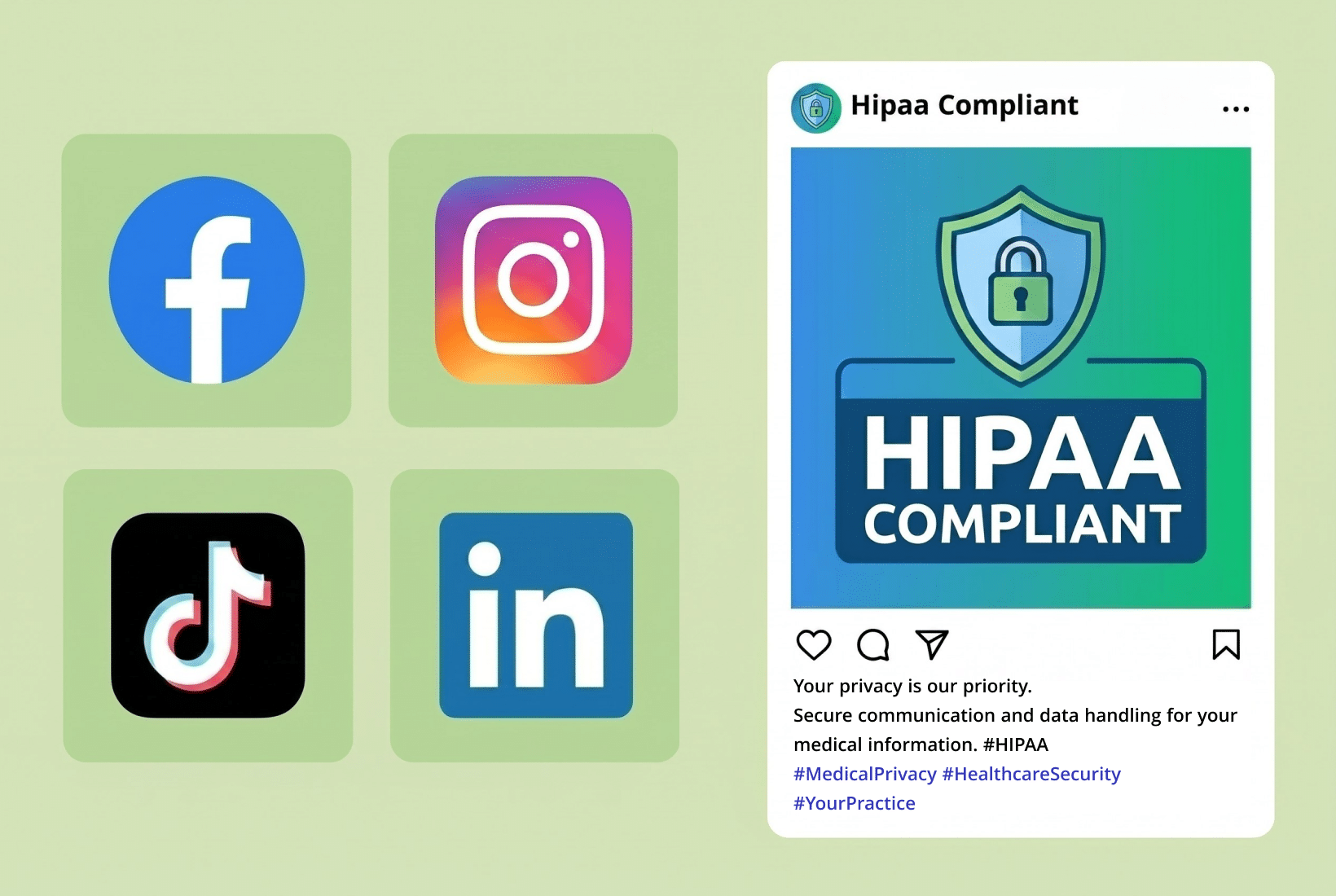
No. None of the four biggest social networks are HIPAA Compliant: not Facebook, Instagram, LinkedIn, or TikTok. Their parent companies won’t sign a Business Associate Agreement (BAA), and none of the platforms were built to hold Protected Health Information (PHI). You can still use all of them legally. You just have to make sure to use them only for marketing and educational purposes that don’t collect or disseminate patient information.
At a glance
| PLATFORM | HIPAA COMPLIANT | WHY / HOW IT CAN STILL BE USED |
|---|---|---|
| No | Meta will not sign a BAA. Safe only for general marketing with no PHI. Tracking pixels and using Leads/Messenger have triggered violations. | |
| No | Owned by Meta; no BAA. DMs have no HIPAA safeguards. Use for awareness and booking hand-offs, never clinical detail. | |
| No | No BAA offered. Fine for recruiting, B2B outreach and thought leadership; never for PHI. | |
| TikTok | No | No BAA, no audit or access controls. General education only; get written authorization for any patient likeness. |
PHI = Protected Health Information. BAA = Business Associate Agreement.
What does “HIPAA-Compliant social media” actually mean?
A platform is not HIPAA Compliant just because it has security features or encryption. Under the HIPAA Privacy and Security Rules, any vendor that creates, receives, stores, or transmits PHI on behalf of a covered entity is a business associate and must sign a Business Associate Agreement (BAA), a contract in which the vendor legally commits to safeguarding PHI and accepts liability for breaches.
This is the single most important test for any tool a healthcare organization uses. If a platform won’t sign a BAA, it cannot lawfully handle PHI. Full stop. Consumer social networks are built for public sharing and advertising, not for confidential health data, so none of them offer a BAA to the general public.
One distinction matters, though. Simply using a platform is not a HIPAA problem on its own. The rules kick in only when PHI actually flows through it. A general wellness tip creates no PHI. A patient’s name sitting next to their condition does, and so does a photo, an appointment detail, or a tracking pixel that quietly sends identifiable data back to the platform.
Is Facebook HIPAA Compliant?
No. Meta, Facebook’s parent company, does not sign BAAs, so Facebook cannot be used to create, receive, store, or transmit PHI. This affects several parts of the platform that healthcare marketers commonly reach for:
- Tracking pixels. The Meta Pixel has been at the center of numerous HIPAA breach lawsuits and regulatory scrutiny. If a pixel on a patient portal, appointment page, or condition-specific landing page sends identifiable data back to Meta, that can constitute an impermissible disclosure of PHI.
- Lead ads and Leads Center. Forms that collect health-related information through Meta are not covered by a BAA, leaving the provider solely liable.
- Messenger. Facebook Messenger has no HIPAA controls and should never carry patient information.
Safe use: Facebook is fine for brand awareness, general health education, community updates, and advertising that targets broad audiences – as long as no PHI is collected, transmitted, or exposed through tracking.
Is Instagram HIPAA Compliant?
No. Instagram is also owned by Meta and falls under the same policy: no BAA, no PHI. On Instagram the usual trouble spot is direct messages. DMs have no HIPAA safeguards at all, meaning no signed BAA, no audit logging, and no access controls. They should never carry a diagnosis, a treatment note, or any detail that identifies a patient.
If a patient sends you PHI in a DM anyway, don’t reply with health details. Move the conversation to a compliant channel and document how you handled it. Think of the DM as a front desk for saying hello and booking, not a place for clinical back-and-forth.
Safe use: Educational posts, reels, behind-the-scenes brand content, and appointment prompts that direct patients to a secure channel.
Is LinkedIn HIPAA Compliant?
No. LinkedIn does not offer a BAA and is not designed to store or process PHI. In practice this is rarely a burden, because LinkedIn’s purpose – professional networking – seldom involves patient data.
Safe use: Recruiting and hiring, B2B outreach, professional thought leadership, and company updates. Just keep patient information off the platform entirely, including in case studies, images, and comments.
Is TikTok HIPAA Compliant?
No. TikTok provides no BAA and lacks the audit trails, access controls, and security architecture required to handle PHI. Its short-video format also creates a specific risk: it is easy to accidentally capture a patient’s face, voice, chart, or room in the background of a clip.
Safe use: General health education and awareness content only. Never discuss identifiable cases, and obtain a signed HIPAA authorization before featuring any patient’s image, voice, or story – even a testimonial.
The hidden risk: tracking pixels and analytics
For most clinics, the biggest social-media compliance risk isn’t a careless post. It’s the invisible tracking code sitting on their own website. Back in December 2022, the U.S. Department of Health and Human Services’ Office for Civil Rights (OCR) warned that tools like the Meta Pixel and Google Analytics could expose PHI when they tie a person’s identity to visits to health-related pages. OCR updated that guidance in March 2024.
The legal picture then shifted. In June 2024, a federal court vacated part of that guidance, ruling that OCR had overstepped by treating an IP address plus a visit to a public, unauthenticated health webpage as automatically triggering HIPAA. OCR chose not to appeal. Even so, compliance experts stress that the underlying risk has not disappeared: if tracking technology transmits genuinely identifiable patient data – especially from authenticated portals or forms – it can still lead to violations, lawsuits, and loss of patient trust.
Practical takeaway on pixels
Audit every tracking pixel, tag, and analytics script on your site. Keep them off patient portals, intake forms, and appointment or condition-specific pages unless you have confirmed no PHI is transmitted – and remember that no social platform will sign a BAA to cover that data.
How healthcare organizations can use social media safely
None of this means clinics should abandon social media. It means drawing a hard line between public marketing and protected information. A few ground rules:
- Never post PHI. No names, faces, conditions, appointment details, or anything that could identify a patient – unless you have written HIPAA authorization on file.
- Treat DMs as a doorway, not a clinic. Use them to greet and route patients to secure channels, never to exchange health details.
- Get written authorization for testimonials and patient stories. Consent must be specific and documented before publishing.
- Audit your tracking and analytics. Know exactly what data each pixel collects and where it goes.
- Move sensitive interactions to compliant tools. Use platforms and forms that will sign a BAA whenever patient information is involved.
- Train your team. Most social-media violations come from well-meaning staff, not bad actors. Clear policies and regular training prevent the majority of incidents.
Frequently Asked Questions
Yes. Having and using these accounts is perfectly legal for healthcare organizations. The rules only come into play when PHI is created, received, stored, or transmitted through the platform.
Collecting patient information through these channels safely
This leaves clinics with a practical problem. You want to turn followers into patients, but you can’t ask them for health details in a comment or a DM. The way around it is to keep the conversation on social and move the actual data collection somewhere compliant. Instead of asking someone to type their information into a message, you send them a link to a secure, HIPAA-Compliant form.
That’s the model HIPAAtizer is built around. You can drop a form link in your bio, a story, a post, or a reply, and whatever the patient submits lands in a vault covered by a signed BAA rather than on the social platform itself. The channel stays public; the PHI never touches it.
Facebook, Instagram, LinkedIn, and TikTok are not HIPAA Compliant, and no setting will change that. The barrier is the missing BAA. Used sensibly, they’re still strong channels for education, awareness, recruiting, and community building. The rule is short: keep Protected Health Information off public social media, and use BAA-backed tools for anything that touches patient data.
Sources & further reading
- HHS OCR – Use of Online Tracking Technologies by HIPAA Covered Entities
- HIPAA Journal – HIPAA Social Media Guidelines
- Fierce Healthcare – Court ruling on HHS web tracker policy
This article is for general educational purposes and does not constitute legal or compliance advice. Consult a qualified compliance professional for guidance specific to your organization.
Still have questions? Contact us